
SEER*Explorer with Statistics through 2023
Released: April 22, 2026
DevCan Lifetime Risk Software
Updated: April 22, 2026
Joinpoint Trend Analysis Software
Updated: March 25, 2026
Cancer surveillance provides a quantitative portrait of cancer and its determinants in a defined population. The core functions of cancer surveillance are the measurement of cancer incidence, morbidity, survival, and mortality for persons with cancer.

Stay up-to-date on everything from DCCPS LinkedIn


Includes the release of new statistics and updated software.
See all Updates
Includes key measures of progress along the cancer control continuum and uses national trend data to illustrate where improvements have been made.
Visit the CTPR Website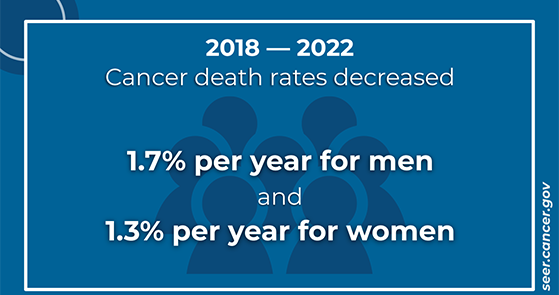
The Annual Report to the Nation on the Status of Cancer is an update of rates for new cases and deaths as well as trends for the most common cancers in the United States.
Read the Report
SEER is an authoritative source for cancer statistics in the United States.
It provides information on cancer statistics in an effort to reduce the cancer burden among the U.S. population. SEER is supported by the Surveillance Research Program (SRP) in NCI's Division of Cancer Control and Population Sciences (DCCPS).
Released: April 22, 2026
Updated: April 22, 2026
Updated: March 25, 2026
March 2, 2026
American Cancer Society
February 5, 2026
JAMA Oncology
January 26, 2026
American Cancer Society

We welcome your comments, questions, and feedback about the new Program or about any of the content on this website. We will read and consider all input and will respond to questions as quickly as possible.
Visit the Contact Page
Updates about initiatives that the Surveillance Research Program (SRP) is spearheading to bring the nation closer to a complete and detailed understanding of the cancer burden.
Visit the Blog
Are you interested in gaining access to funding opportunities, event information, and research insights from NCI's Division of Cancer Control and Population Sciences (DCCPS)? We invite you to follow the DCCPS LinkedIn page.
Follow DCCPS